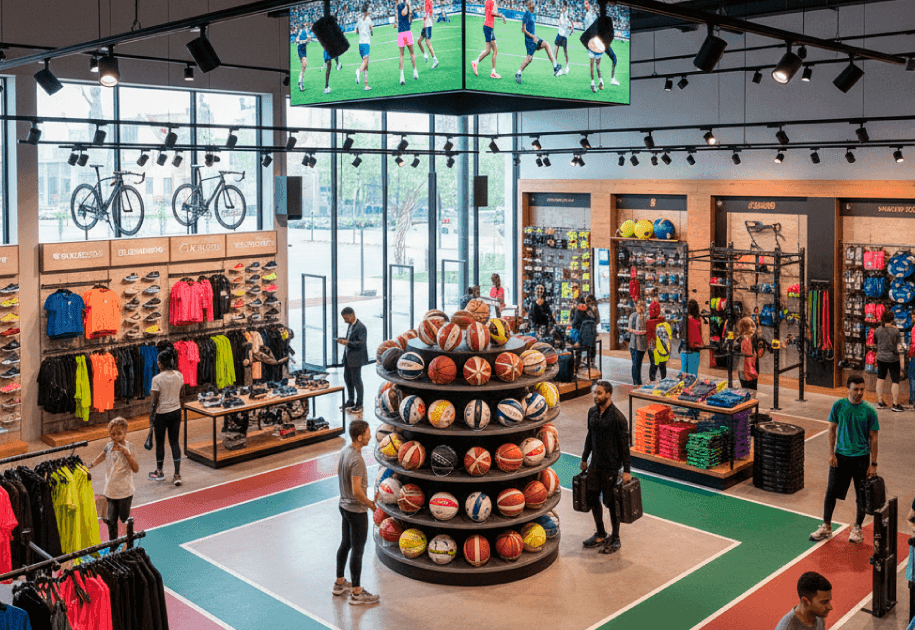
There's a question that Winnin's Cultural Intelligence Report puts pretty bluntly on the table for retail: if major global sports events bring billions of people together at the same time — creating one of the most powerful attention windows in the entire calendar — why is retail consistently one of the categories that engages least in that context?
"The New Era of Sports Fandom" analyzed over 8 million videos, 430 billion views, and 21 billion engagements across global sports events over the past three years. The engagement data by industry tells a clear story — and retail needs to hear it before 2026.
The number retail needs to sit with
In North America, retail ranks second to last in engagement by industry at global sports events, with 3.8M total engagements over the past three years. In Latin America, it's even worst: last, with 2.1M.
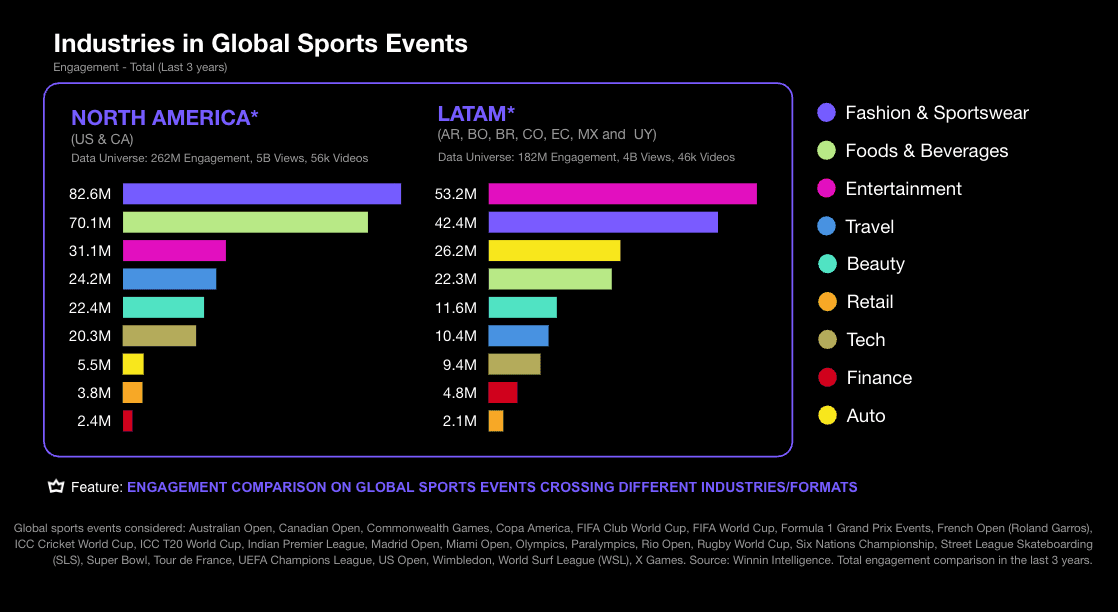
For context: Fashion & Sportswear, the category leader in North America, clocked 82M. Foods & Beverages came in second with 70M. Even Beauty — a category most people still don't instinctively associate with sports — generated more engagement than retail in both regions.
This isn't a problem with sports relevance for retail consumers. It's a problem with how the category is — or isn't — activating inside sports culture.
What's happening in sports culture that retail hasn't caught up with
Major sports events still work as cultural campfires — moments that pull billions of people toward the same conversation at the same time. What's changed radically in recent years is everything that happens around the flame.
While traditional sports media remains consolidated, alternative sports media — streamers, podcasters, independent publishers, creators — has exploded. The official game is just one version of the story. The other versions — the rituals, the aesthetic trends, the colliding fandoms, the belonging narratives — are where sports culture actually lives. And those are exactly the territories where retail has untapped potential.
Winnin calls this Passion Fusion: the merging of distinct fandoms that creates new content and reaches audiences well beyond the original niche. Soccer meets Anime. F1 meets Fortnite. Rugby meets Beauty. Each of these fusions carries a latent demand for products, experiences, and aesthetic expression — and retail is largely absent from that conversation.
What other categories are doing — and what retail can learn from them
Samsung didn't activate at the Paris 2024 Olympics as a tech brand. It activated as a culture brand. The "Victory Selfie" campaign treated athletes as 360° icons and turned the podium into real-time content — hacking the most-watched moment of the event to create a format that resonated with the "aesthetic fan": the consumer who connects with sports culture through visual identity and cultural codes, not just competition.
Hello Kitty did something similar at F1 Academy: built an experience that pulled pop culture, fashion, and beauty fans into motorsport, generating over 144 videos and 1 million engagements around a single event — the Las Vegas Grand Prix.
And Budweiser, by turning a sponsorship crisis at the 2022 World Cup into a cultural campaign, saw brand mentions in video content grow by +1,900% during the tournament.
What these three cases share isn't budget or sector. It's the decision to enter the culture the event generates, not just show up at the event itself. Retail hasn't found its version of that equation yet.
Where the real opportunity for retail sits in 2026
Winnin's report identifies concrete cultural signals already forming ahead of the 2026 World Cup — and they open specific territories for retail.
The first is the return of 2016 aesthetics. The "2016 is back" trend grew over 90% in video production between October and December 2025. For retail, that means collections, window displays, campaigns, and experiences that speak to the visual codes of that year have real cultural territory to occupy — not as forced nostalgia, but as part of a conversation consumers are already having.
The second is the underdog narrative. At the FIFA Club World Cup, Latin American clubs like Flamengo, Palmeiras, and Botafogo generated more engagement than tournament winner Chelsea and European giants like PSG and Real Madrid — because audiences connected with regional pride and belonging that runs deeper than athletic performance. For 2026, people will actively seek out a "second team" to root for. Retail that builds activations around those stories — not just the favorites — will find a far more engaged audience.
The third signal is AI as a cultural remixing tool. AI-powered soccer content averaged 47% more views than traditional soccer content over the past 12 months. The 2026 World Cup will be experienced both in stadiums and across fan-created, AI-powered alternative versions of it. Retail that can create products, limited editions, or experiences that enter those conversations will capture attention traditional sponsorship simply can't reach.
The sports fan retail isn't seeing
One of the report's sharpest insights is that the "sports fan" as a single persona is gone. What exists instead are consumers who connect with sports culture through different entry points — aesthetics, belonging, identity, entertainment — and who bring other passions along with them.
Soccer meets Anime creates demand for products that speak to both worlds. Baseball meets Swifties opens territory that neither baseball nor pop music could reach alone. Rugby meets Beauty shows that the sports consumer is also a style and self-care consumer.
Retail is in a uniquely strong position to capture these intersections — through collaborative collections, limited-edition drops, in-store experiences that reflect the event's cultural energy, or content that enters the conversations fandoms are already having. The opportunity isn't missing. The cultural intelligence to see it is.
Three questions to change the game in 2026
Is your sports activation talking to the fan — or to a simplified version of one?
The report is clear: the sports fan no longer exists as a single persona. Relevance now lives at the intersection of sports and the consumer's other passions. Retail that keeps activating for "the fan" will keep generating the engagement numbers the data shows today.
Are you showing up early enough?
The cultural signals around the 2026 World Cup are forming right now. "2016 is back" started months before the tournament. The underdog narrative has been building since the FCWC. Cultural intelligence means acting while the conversation is still forming — not after it's already peaked.
What's the genuine intersection between your brand and sports culture?
This isn't about sponsorship. It's about finding where your brand's territory authentically overlaps with what sports fandoms represent — and building from there. That's the way out of second to last.
This article is based on data from Winnin's Cultural Intelligence Report "The New Era of Sports Fandom," which analyzed over 8 million videos, 430 billion views, and 21 billion engagements across global sports events over the past three years, covering LATAM, North America, Europe, and APAC.