Food & Beverage doesn't need to earn its place at the sports table. Cold beer, game day snacks, energy drinks — the connection has been there for decades, and everyone knows it. That's actually the problem: when a category feels too obvious, brands stop thinking hard about it.
Winnin's Cultural Intelligence Report "The New Era of Sports Fandom" analyzed over 8 million videos, 430 billion views, and 21 billion engagements across global sports events over the past three years. What the data shows for F&B goes beyond confirming the category matters. It reveals why some brands dominate the conversation while most just show up in it.
F&B is the #2 industry in sports engagement in North America. So why is it #4 in LATAM?
In North America, Foods & Beverages ranks second in total engagement at global sports events over the past three years, with 70M — trailing only Fashion & Sportswear (82.6M) and ahead of Entertainment, Beauty, Travel, Tech, Auto, and Retail.
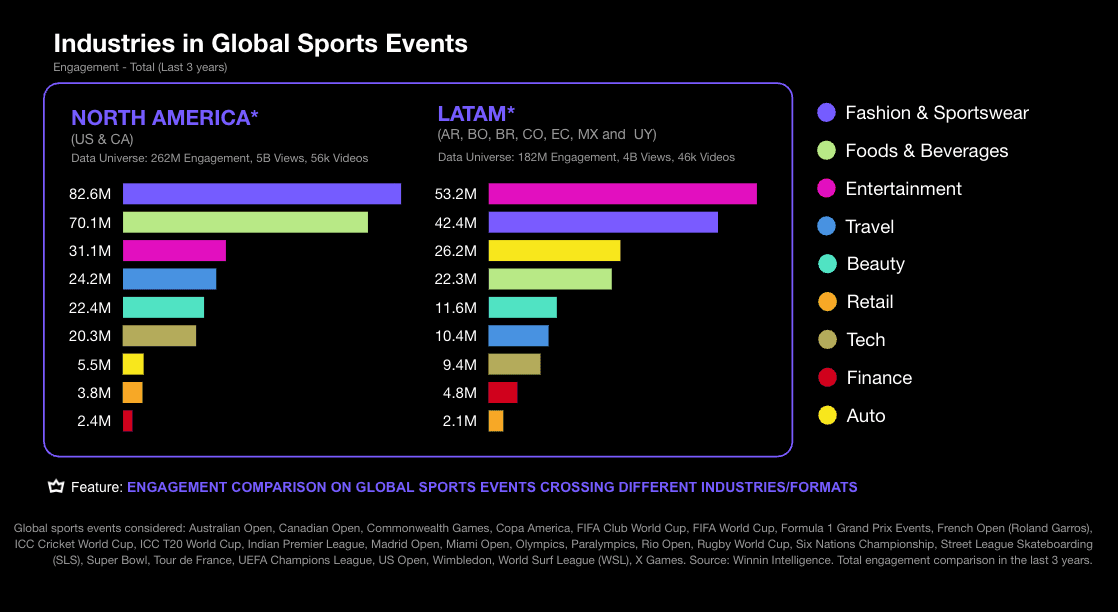
In Latin America, the picture looks different: F&B drops to fourth place, with 22M in engagement. Entertainment (53.2M) and Fashion & Sportswear (42.4M) lead, followed by Auto (26M).
That regional gap isn't random. It tells a story about how Latin American consumers experience sports culture — and where the category still has significant room to grow.
Unified focus doesn't mean unified narrative. That changes everything for F&B
Major sports events still act as cultural campfires. The World Cup, the Olympics, the Super Bowl — they pull billions of people toward the same moment at the same time. But what Winnin's data makes clear is that shared focus doesn't produce shared narrative.
While traditional sports media remains consolidated, alternative sports media — streamers, podcasters, independent publishers, creators — has exploded over the past three years. The official game is just one version of the story. What happens around it — the rituals, the celebrations, the memes, the game day recipes — is where sports culture actually lives.
For F&B, that's a massive opportunity. The category doesn't need to force its way into the sports conversation. It's already part of the ritual. The question is whether brands are being genuinely relevant inside that conversation — or just present.
Passion Fusion: when sports and culture collide, F&B has a natural seat at the table
Winnin identifies a phenomenon in the report called Passion Fusion — the merging of distinct fandoms that creates new content and reaches audiences well beyond the original niche. Soccer meets Anime. F1 meets Fortnite. Baseball meets Swifties.
F&B sits at the center of many of these fusions without brands even realizing it. Game day food culture crosses sports with gastronomy, family, and entertainment. World Cup-themed recipes blend soccer with lifestyle. Athlete-endorsed drinks connect performance with identity.
When two passion territories collide, both grow. F&B brands that get this stop activating around the event and start activating inside the culture the event generates.
What the Budweiser case teaches about timing and cultural courage
In 2022, the Qatari government banned beer sales at World Cup stadiums just days before the tournament started. For Budweiser, an official sponsor, it could have been a textbook sponsorship crisis. Instead, the brand donated all the beer intended for the tournament to the winning country.
"Bring Home the Bud" didn't just flip the narrative — it generated results that most traditional sponsorships can't touch. Mentions of Budweiser in video content during the 2022 World Cup increased by +1,900%. That's 330 creators, averaging 158k views per video and 38k engagements per video.
That number isn't really about crisis management. It's about cultural intelligence applied in real time. Budweiser read the moment, understood what would resonate, and moved fast enough to turn a setback into a cultural conversation. That's the difference between showing up and winning attention.
2016 is back — and there's a lot of room for F&B in that story
One of the strongest cultural signals Winnin's report identifies for 2026 is the return of 2016 aesthetics. The "2016 is back" trend grew over 90% in video production between October and December 2025. And the crossover with World Cup anticipation is already happening — "World Cup Summer" as an aesthetic and cultural concept is gaining real traction.
For F&B, that's a concrete signal. Products, packaging, campaigns, and experiences that tap into 2016 nostalgia — the flavors, the rituals, the celebration moments from that tournament — have cultural territory to occupy. Not as a forced reference, but as part of a conversation consumers are already having.
Underdogs, belonging, and the opportunity most brands are sleeping on
Winnin's report shows that the underdog narrative has stopped being a surprise and become a structural expectation of major tournaments. At the FIFA Club World Cup, Latin American clubs like Flamengo, Palmeiras, and Botafogo generated more engagement than tournament winner Chelsea and European giants like PSG and Real Madrid — because audiences connected with regional pride and belonging narratives that go deeper than athletic performance.
For 2026, audiences will actively go looking for a "second team" to root for. F&B brands that understand this can build activations around those stories — not the final score, but what the tournament means for different communities.
Relevance doesn't come from sponsoring the favorite. It comes from understanding which story your consumer actually wants to be part of.
What AI changes for F&B in sports contexts
The report shows that AI-powered soccer content averaged 47% more views than traditional soccer content over the past 12 months. Fans are creating alternative match outcomes, simulated results, and AI-generated analysis — and these narratives circulate with as much engagement as the official ones.
For F&B brands, that means the 2026 World Cup won't be defined only by what happens on the field. The most relevant conversations will unfold in the remixed, fan-created versions of the tournament. Brands that can show up in those spaces — not just in official broadcasts — will capture attention that traditional sponsorship simply can't reach.
Three questions to sharpen your 2026 strategy
Before running the same sports activation playbook again, it's worth pressure-testing a few things:
Is your brand part of the ritual — or just the event?
F&B is woven into how people experience sports. But that doesn't make presence automatic. The brands that own the conversation are the ones that become part of the moment itself, not just the sponsorship around it.
Are you moving at the right speed?
The Budweiser case didn't work because it was planned months in advance. It worked because the brand reacted in real time. Cultural intelligence means tracking what's forming now — not what's already consolidated.
Do you know which narrative your consumer actually wants to connect with?
With audiences shattered into infinite niches, relevance lives at the intersection of passions. Understanding where your brand's territory overlaps with sports culture — and which story resonates with your consumer in that moment — is what determines whether you enter the conversation or just appear in it.
This article is based on data from Winnin's Cultural Intelligence Report "The New Era of Sports Fandom," which analyzed over 8 million videos, 430 billion views, and 21 billion engagements across global sports events over the past three years, covering LATAM, North America, Europe, and APAC.