
Banks plaster their logos across F1 barriers. Insurers sponsor World Cups. Fintechs compete for stadium naming rights and tennis tournament titles. The financial industry understands that major sports events are one of the biggest visibility platforms on the planet — and invests accordingly.
But there's a data point in Winnin's Cultural Intelligence Report "The New Era of Sports Fandom" that every finance CMO should read carefully: finance is the last-ranked category in cultural engagement at major global sports events. Not second to last. Last.
The report analyzed over 8 million videos, 430 billion views, and 21 billion engagements across global sports events over the past three years. What the data reveals isn't that finance is absent from sports — it's that it's present in the wrong way.
The number that defines the problem
In Latin America, Finance recorded just 4.8 million in total engagement at global sports events over the past three years — the second lowest figure across all industries analyzed. In North America, the result is even smaller: 2.4 million, in last place.
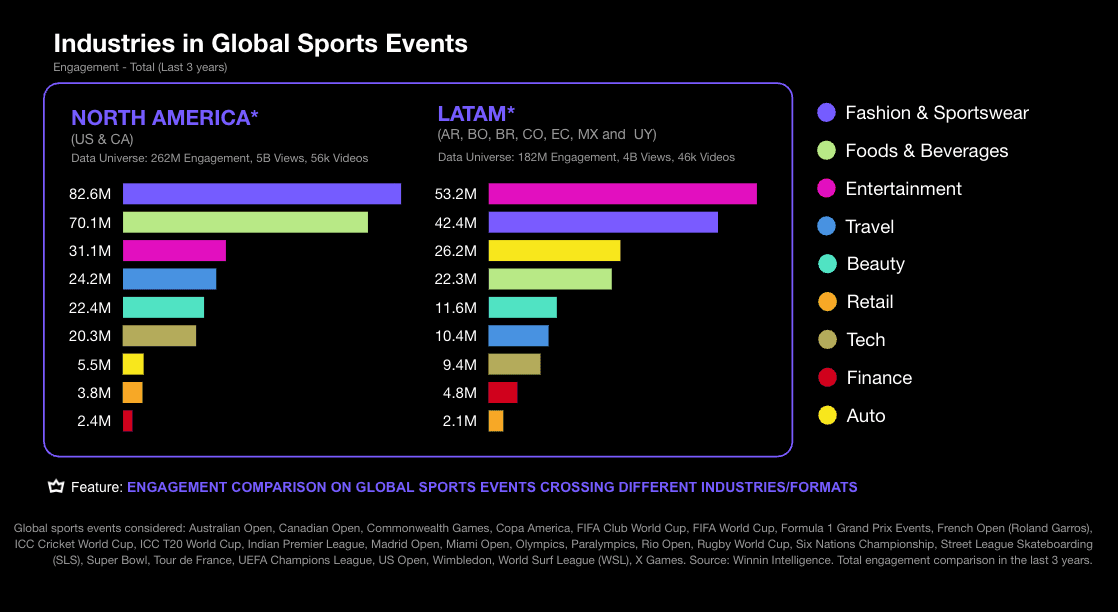
For context: Fashion & Sportswear led with 82.6M in North America. Foods & Beverages totaled 70.1M. Even categories without an obvious sports connection — like Beauty (22.4M in NA) — generated dramatically more cultural engagement than Finance in both regions.
That raises a direct question: if sponsorship investment is high, why is cultural engagement return so low? The answer lies in the difference between buying visibility and entering the conversation.
Sponsorship and cultural relevance aren't the same thing
Major sports events still work as cultural campfires — moments that pull billions of people toward the same conversation at the same time. But what Winnin's data makes clear is that unified focus doesn't produce unified narrative.
While traditional sports media remains consolidated, alternative sports media — streamers, podcasters, independent publishers, creators — has exploded over the past three years. The official game is just one version of the story. The other versions — the rituals, the fandom collisions, the belonging and identity narratives — are where sports culture actually lives.
Finance has historically activated in the foreground: logo on the scoreboard, banner on the F1 barrier, signage on the tennis court. But the cultural conversation those events generate happens somewhere else entirely — and finance hasn't figured out how to enter it in a meaningful way.
What other categories are doing — and what finance can learn
Samsung didn't activate at the Paris 2024 Olympics as a tech brand. It activated as a culture brand. The "Victory Selfie" campaign turned the podium into real-time content, treating athletes as 360° icons and creating a format that resonated with the "aesthetic fan" — the consumer who connects with sports culture through identity and visual codes, not just competition.
Budweiser, facing a last-minute beer ban at the 2022 Qatar World Cup, didn't freeze in the face of a sponsorship crisis. It donated all the tournament beer to the winning country and turned the obstacle into a cultural moment. Brand mentions in video content during the Cup grew by +1,900% — 330 creators, averaging 158k views and 38k engagements per video.
And Hello Kitty, partnering with F1 Academy for the Las Vegas Grand Prix, generated over 144 videos and 1 million engagements around a single event — pulling pop culture, fashion, and beauty fans into motorsport.
What these three cases share isn't sector or budget. It's the decision to enter the culture the event generates, not just show up at the event. Finance has the resources to do this. What's missing is the cultural intelligence to know how.
Where the real opportunity for finance sits in 2026
Winnin's report identifies concrete cultural signals already forming ahead of the 2026 World Cup — and they open specific territories for brands willing to read them.
The first is Passion Fusion: the merging of distinct fandoms that creates new content and reaches audiences well beyond the original niche. Soccer meets Anime. Baseball meets Swifties. F1 meets Fortnite. Each of these fusions carries an audience that isn't the "traditional fan" — it's young, culturally fluid, and consuming the event as part of a broader identity. For fintechs especially, this is exactly the audience that needs to be won.
The second signal is the return of 2016 aesthetics. The "2016 is back" trend grew over 90% in video production between October and December 2025, and the crossover with World Cup anticipation is already happening. For finance, this means campaigns and experiences that tap into the nostalgia and optimism of that year have real cultural territory to occupy — especially for brands that want to associate with the tournament's energy without depending solely on stadium signage.
The third is the underdog narrative. At the FIFA Club World Cup, Latin American clubs like Flamengo, Palmeiras, and Botafogo generated more engagement than tournament winner Chelsea and giants like PSG and Real Madrid — because audiences connected with regional pride and belonging that runs deeper than athletic performance. For financial brands with strong regional presence, backing these narratives — not just the global favorites — can forge a far more genuine connection with local audiences.
The fan finance isn't seeing — yet
One of the report's sharpest insights is that the "sports fan" as a single persona is gone. What exists instead are consumers who connect with sports culture through different entry points — aesthetics, belonging, entertainment, identity — and who bring other passions along with them.
For finance, this is especially relevant. The young consumer who watches F1 also follows pop culture, gaming, and fashion. The fan tracking the World Cup is also thinking about exchange rates and international transfers. The person heading to the stadium is also using a payment app to buy the ticket, the jersey, and the beer.
The opportunity isn't in putting a logo on the scoreboard. It's in finding the moments where the consumer's financial life intersects with their sports experience — and building content, products, and activations that genuinely live at that crossroads.
AI is changing the game for finance too
The report shows that AI-powered soccer content averaged 47% more views than traditional soccer content over the past 12 months. In the past year alone, AI-related World Cup content generated over 900k engagements from just 168 videos. The 2026 World Cup will be experienced both in stadiums and across fan-created, AI-powered alternative versions of the tournament.
For financial brands, this opens an underexplored territory: tools, experiences, and content that enter the digital conversations forming around the tournament — not just the official broadcasts that are already oversaturated with sponsorship.
Three questions to change the ROI in 2026
Is your brand buying visibility or building relevance?
Sponsorship guarantees presence. Cultural intelligence guarantees conversation. The data shows finance has the first and is missing the second. The question isn't whether to invest in sports — it's what the brand is doing with that investment beyond the logo.
Are you activating for the event or for the culture the event generates?
The biggest engagement spikes happen outside the official game — in fandom collisions, belonging narratives, and the identity conversations that major events catalyze. Finance brands that only show up on the scoreboard are missing the most valuable part of the attention window.
What's the genuine intersection between your brand and the sports consumer's life?
This isn't about finding an athlete to sponsor. It's about understanding where the consumer's financial experience meets their sports experience — and building from there. That's the way out of the last places.
This article is based on data from Winnin's Cultural Intelligence Report "The New Era of Sports Fandom," which analyzed over 8 million videos, 430 billion views, and 21 billion engagements across global sports events over the past three years, covering LATAM, North America, Europe, and APAC.